
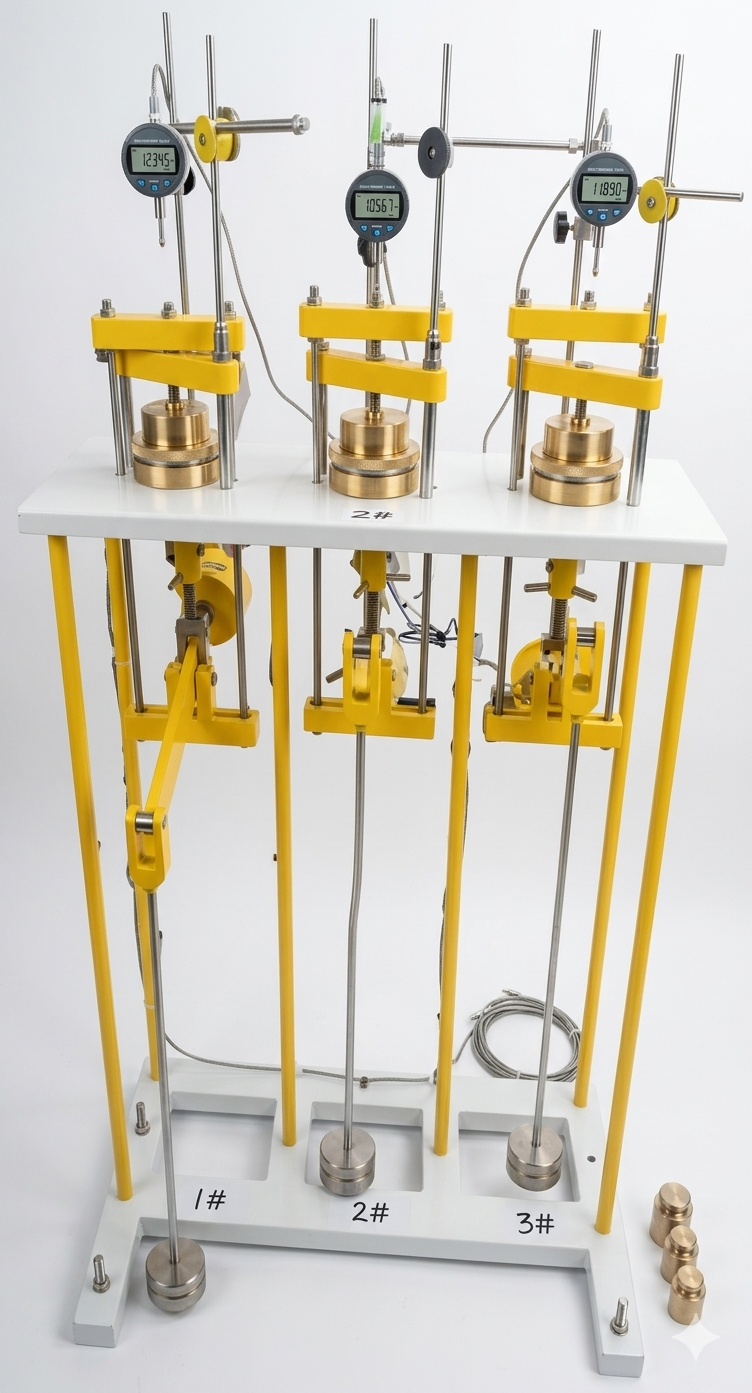
Description
| Section | Description |
|---|---|
| Reference Standards | IS:2720 (Part XV), IS:12287, BS:1377, ASTM D2435 |
| Application | Consolidation of clay deposits can lead to settlement, cracks, and structural failures in buildings and foundations. Consolidation is the reduction in soil volume caused by expulsion of water from pore spaces under sustained loading conditions.Since consolidation is a time-dependent phenomenon, the one-dimensional consolidation test performed on undisturbed clay samples is highly useful for studying the history and compressibility characteristics of soil deposits.The test results are widely used for calculating settlement behavior of structures constructed on clayey soils. |
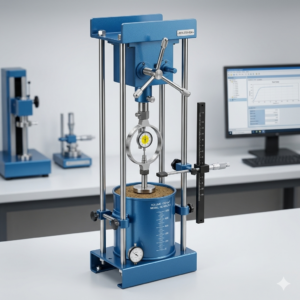
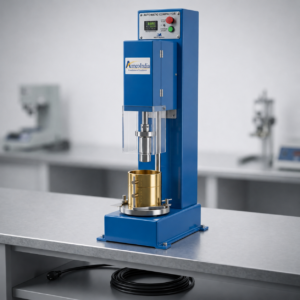
| Consolidation Apparatus | The standard outfit comprises a fixed ring type consolidometer cell suitable for testing soil specimens of 60 mm diameter × 20 mm thickness.
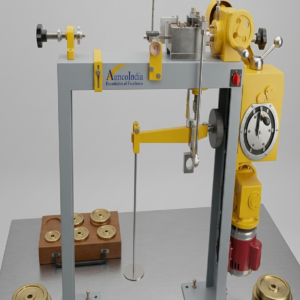
The apparatus is designed to accommodate specimens ranging from 50 mm diameter to 100 mm diameter. The same loading unit can also be used with floating ring consolidometer cells, available optionally at extra cost. The standard outfit is supplied with a set of weights capable of providing a total pressure of 10 kg/cm² in addition to a seating load of 0.05 kg/cm² on the specimen. An additional set of weights is required for achieving the full loading capacity of 20 kg/cm². Necessary accessories for performing the Variable Head Permeability Test can also be supplied optionally. Three-gang and six-gang outfits are available, allowing mounting of three or six consolidometer units on a single frame. Consolidation measurements can be taken either through conventional dial gauges or by using transducers with electronic readout units. |